

Buying an infrared camera is a significant commitment. Even though prices have fallen dramatically over the past few years, it’s still important to ensure the chosen model represents the best value for money and that it will serve you well in the long term. For some, cost will be the driving force, while for others, key hardware or software features are more important.
While dynamic development continues to extend the application potential of thermography, it also presents the purchaser with a lot of choices. The range now extends from pocket-sized models, to low cost point-and-shoot troubleshooting cameras and through the high end models with every function necessary for the professional thermographer. So how do you assess the best model for your needs? Here are some important pointers.
Buy the best your budget allows
Most thermal imaging cameras have fewer pixels than visible light cameras, so pay close attention to detection resolution. Higher resolution infrared cameras can measure smaller targets from farther away and create sharper thermal images, both of which add up to more precise and reliable measurements.
Also be aware of the difference between detector and display resolution. Some manufacturers will boast about a high resolution LCD to mask their low resolution detector when it’s the detector resolution that matters most.
For instance, LCD resolution may spec at 640 x 480, capable of displaying 307,200 pixels of image content. But if the IR detector pixel resolution is only 160 x 120, giving 19,200 measurement points, the greater display resolution accomplishes nothing as the quality of the thermal image and its measurement data are always determined by detector resolution.
Higher resolution thermal imaging not only provides more accurate quantitative results, it can also be very effective in showing findings in finer details to others. This can help speed the decision-making process for improvements and repairs.
Accurate and repeatable results
Consistency of measurement accuracy is a very important factor when determining the value of a camera. For best results, look for a model that meets or exceeds ±2% accuracy and ask your supplier for details of how they assure the manufacturing quality of the detector to guarantee this. That isn’t the only criteria, however.
In order to produce correct and repeatable results, your camera should include in-built tools for entering both values for emissivity – the measure of efficiency in which a surface emits thermal energy – and also reflected temperature.
A model that gives you an easy way to input and adjust both of those parameters will produce the accurate temperature measurements you need in the field. Other helpful diagnostics to consider are multiple moveable spots and area boxes for isolating and annotating temperature measurements that can be saved as radiometric data and incorporated into reports.
Standard file formats
Many thermal imaging cameras store images in a proprietary format that can only be read and analysed by specialised software. Others have an optional JPEG storage capability that lacks temperature information. Clearly, the most useful is a format that offers standard JPEG with full temperature analysis embedded. This allows you to email IR images without losing vital information.
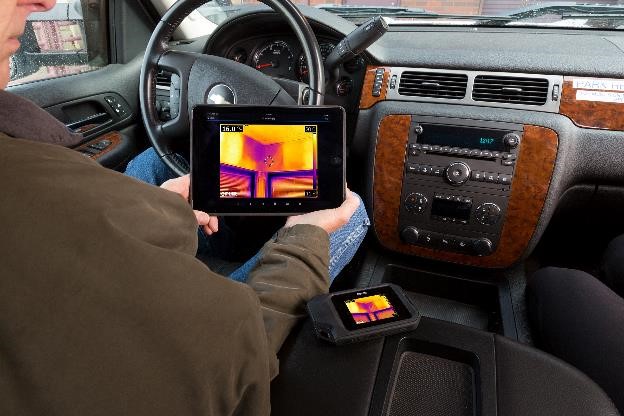
Radiometric JPEGs can also be imported from wi-fi compatible cameras to select mobile devices using apps that allow further image editing, analysis and sharing. Also look out for models that allow you to stream MPEG 4 video via USB to computers and monitors. This is especially useful for capturing dynamic thermal activity where heating and cooling occurs rapidly and for recording motorised equipment or processes in motion.
Some cameras feature composite video output for cabling to digital recorders while others include HDMI outputs. And new mobile applications have also be developed that allow streaming video over wi-fi. All these capabilities help you share findings more effectively and enhance your infrared inspections and reports.
Software, study the options
Today most thermal imaging cameras come with free software so you can perform basic image analysis and create simple reports. Advanced software for more in-depth and customisable reports is also available, allowing you to take full advantage of your camera’s capability and features. Investigate these tailored software programmes thoroughly to see which makes the most sense for your needs.
And finally, don’t underestimate the importance of training. The best thermal imaging camera in the world is only valuable in the hands of a skilled operator.