


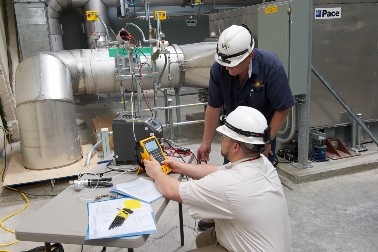

Fluke Corporation was founded in 1948, specializing in electrical test and measurement products. Early in its history, Fluke recognized that the very best electrical metrology would be needed to support its products and undertook to develop this capability. From this activity, the calibration business was born. Over the years, many breakthrough calibration products were introduced, establishing Fluke as a leader in electrical metrology. In 2001, Fluke’s calibration business expanded into the temperature field with the acquisition of Hart Scientific, and then into pressure and gas flow with the acquisition of DH Instruments (2007), followed by Ruska and Pressurements (2010).
Fluke Calibration brings together the original Fluke electrical calibration business, Hart Scientific, DHI, Ruska and Pressurements in one unified, worldwide organization. The unified business’s unmatched breadth and depth in metrology put Fluke in a unique position to deliver today’s and tomorrow’s calibration solutions to users who demand the very best, supported by an organization they can count on over the long term.
At the same time, Fluke carries forward the tradition of discipline specific measurement expertise and customer driven focus that come with its small, high performance company heritage.
Electrical calibration
Electrical calibration refers to the process of verifying the performance of, or adjusting, any instrument that measures, sources, or tests electrical parameters. This discipline usually referred to as dc and low frequency ac electrical metrology. Principal parameters include voltage, current, resistance, inductance, capacitance, time and frequency. Other parameters, including electrical power and phase, are also in this segment of metrology. Ratiometric comparisons of similar parameters are often performed to compare a known parameter to an unknown similar parameter.
RF calibration
RF and microwave calibration refers to the process of verifying the performance of, adjusting/deriving corrections for, any instrument or component that will be used in the measurement or testing of RF and microwave parameters. This discipline is usually referred to as RF and microwave metrology. Principal parameters include RF voltage, RF power, impedance, modulation, distortion, time, frequency and phase. High dynamic range ratiometric comparisons are often performed and results are expressed in the logarithmic “dB”form.
Temperature calibration
Temperature calibration refers to the calibration of any device used in a system that measures temperature. Most importantly, this usually means the temperature sensor, itself, which is typically a platinum resistance thermometer (PRT or PT-100), thermistor, or thermocouple. Readings from these thermometers are made by “thermometer readout” devices which measure their electrical outputs and convert them to temperature according to the International Temperature Scale of 1990 (ITS-90).
Pressure calibration
Pressure calibration is the comparison of the output of a device used to measure pressure with that of another pressure measurement device, or pressure measurement standard. This usually involves plumbing the unit under test (UUT) to the standard device and generating a common pressure in the measurement circuit. The outputs of the devices are compared at one or more pressures, typically from the lowest to highest readings of the UTT’s full scale range, or the range over which it is normally used.
Gas flow calibration – What is it?
Gas flow calibration refers to the calibration of a flow sensing device such as a flow meter or flow controller by comparing its measurement against a flow measurement reference. Typically, the device, or unit under test (UUT), is pneumatically connected in series with the flow reference so they measure the same gas flow; then the indications of the two devices are compared.